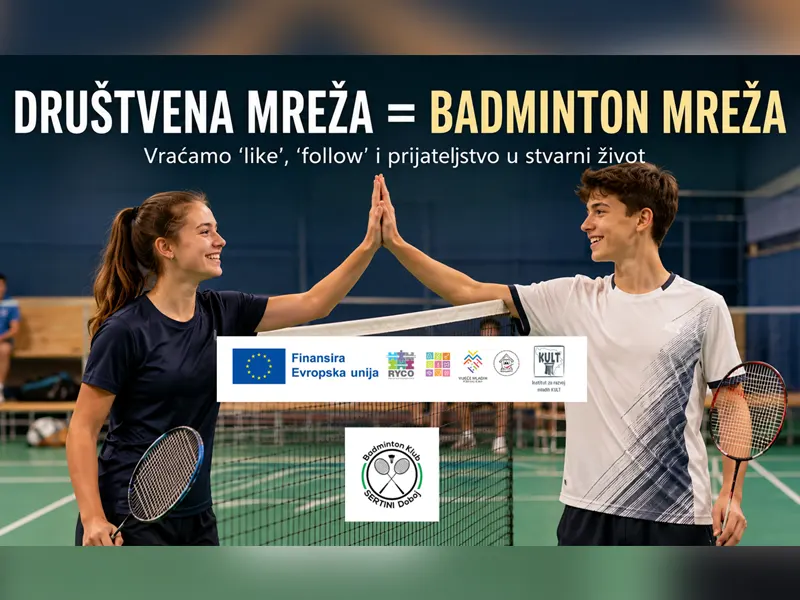
We're bringing like, follow and friendship back to real life
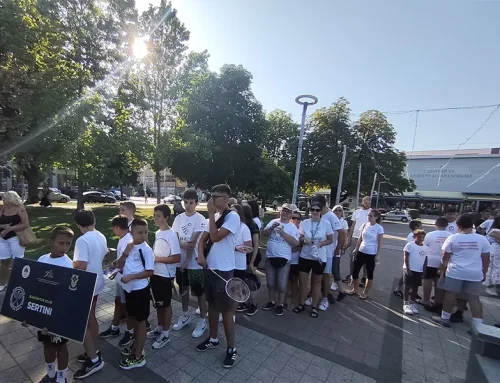
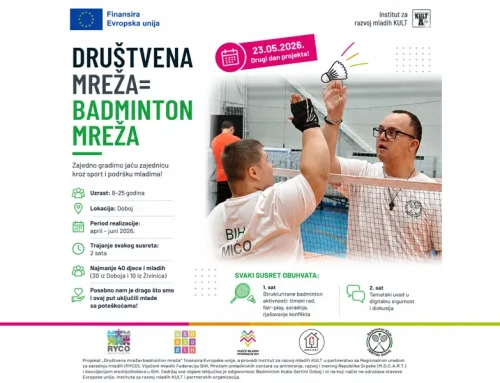
It is precisely on this idea that the project **”Social Network = Badminton Network”** was created, which is implemented by **Badminton Club Sertini Doboj**.
This is not a project against the internet, phones or social media. Quite the opposite. The goal is to teach children and young people to use technology smarter, safer and more moderately, but at the same time to rediscover what no screen can replace – movement, socialising, conversation, friendship, belonging and real contact with other people.
A like is nicer when you get it live
We want to offer a different network.
**Badminton net.**
The net over which the ball travels from one child to another. A network around which different generations gather, girls and boys, children from different cities, communities, schools and communities.
On this network:
**LIKE** is applause after a good point.
**FOLLOW** is when you follow a friend to training.
**SHARE** is when you share the court and racket.
**COMMENT** is advice from a teammate or coach.
**STORY** is a memory that you really experienced.
**PROFILE** is not a photo – it’s a character you build.
**FRIEND REQUEST** starts with an extended hand.
And the best **NOTIFICATION** is the message: “See you at training.”
Badminton as a response to the decreasing movement of children
It is one of the sports that simultaneously develops a large number of abilities important for the proper development of a child.
Through badminton we develop:
- coordination of hand, leg and whole body movements;
- reaction speed and reflexes;
- explosiveness and agility;
- balance and stability;
- spatial orientation;
- hand-eye coordination;
- the ability to estimate the speed, direction and trajectory of objects;
- peripheral vision and tracking a moving object;
- concentration and attention;
- making decisions in a very short time;
- endurance and general physical fitness;
- proper body posture;
- self-confidence;
- discipline and responsibility;
- respecting the rules, opponents and teammates.
A child on the badminton court does not have time to passively observe the content.
It must **see, assess, decide, react and move**.
This is exactly why badminton can be an extremely powerful tool at a time when children spend more and more hours sitting in front of phones, computers and televisions.
We do not ban social networks - we teach children to use them
It is unrealistic to expect that children and young people will stop using the Internet. Nor is that the goal.
The goal is for them to know where the fun ends and the risk begins.
That is why, through the project, we talk about the protection of personal data, secure passwords, fake profiles, scams, unknown links, photos that remain on the internet, cyberbullying, communication with strangers, excessive phone use, and content that children may be exposed to on a daily basis.
The most important thing is to develop **digital responsibility**.
The phone and the Internet should be a tool, not the center of a young man’s life.
Social networks can be used for learning, promoting sports, connecting, sharing knowledge, creativity and communication.
But we also have to teach children when it’s time to put the phone away.
A real social network knows no difference
The special value of the project is its openness.
On the badminton court, it matters less where you come from, what city you belong to, what your name is, what your gender is, what your social status is, or how active you have been in sports before.
The network is the same for everyone.
That is why, through the project, we promote **inclusion, equality between girls and boys, mutual understanding, cooperation between young people from different communities, multiethnicity, tolerance and equal opportunities for participation**.
We especially want to open the space to children and young people who may not have previously found their place in traditional sports systems, as well as to young people with disabilities for whom sport can represent an important space for socialization, self-confidence, and belonging to a group.
Because sport has one huge advantage.
Before we know who’s who – we’ve already started playing.
From project to system solution
Our next goal is much bigger.
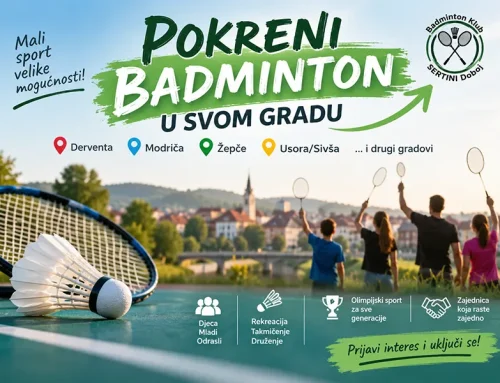
We want to develop a **systemic model connecting badminton, schools, children, youth, sports organizations and local communities**, through which badminton would become accessible to a greater number of students.
The idea is simple: to come where the children are already – in schools.
To enable the promotion of sports, introducing students to the basics of badminton, organizing school activities and competitions, identifying talents and their further inclusion in clubs and the sports system.
From the first contact with a racket in the school gym to local competitions.
From local competition to national championship.
And for the most persistent and talented – one day, even to the European and world badminton courts.
That is the system we want to build.
European values that are not just learned from books
Supporting projects like this shows how important it is to invest in youth that simultaneously connects education, sports, digital safety, a healthy lifestyle, and social inclusion.
The project **”Social Network = Badminton Network” is implemented by the Badminton Club Sertini Doboj, with the financial support of the European Union and the Institute for Youth Development KULT.**
With this support, the project has allowed an idea that started around a single badminton net to take on a much broader meaning.
The values that the European Union continuously promotes – **equality, inclusion, cooperation, respect for diversity, active citizenship, connecting communities, gender equality and creating opportunities for youth** – are not just written in a project document here.
They were transferred to the field.
Through playing together.
Through conversation.
Through education.
Through new acquaintances.
And through a network that does not separate people with a screen, but connects them face to face.
That is why **”Social Network = Badminton Network”** stands out as one of the most notable projects implemented by **Badminton Club Sertini Doboj**, but also as a project that has the potential to grow beyond its initial project framework.
The support of the **European Union and the Institute for Youth Development KULT** enabled this idea to take concrete form, to bring together children and youth and show how sport can simultaneously be a means of education, inclusion, digital literacy and community connection.
For **Badminton Club Sertini Doboj** this is not the end of a project. This is the beginning of an idea that we want to turn into a long-term and systemic solution.
The next step is the system.
More schools.
More cities. Register your city so we can participate together.
More children.
Multiple partners.
More true friendships.
Because perhaps the biggest revolution today is not to create yet another new social network. Provide a little, and we’ll give you a lot.
Perhaps the revolution is to return children to the one that already exists.
**On the right network.**
**Badminton net.**
The article was created within the framework of the project “Let’s think, create and adopt youth policies” funded by the European Union and implemented by the Institute for Youth Development KULT in partnership with the Regional Youth Cooperation Office (RYCO), the Youth Council of the Federation of BiH, the Network of Youth Centers for Animation, Development and Training of the Republika Srpska (MOCART) and the Association of High School Students in BiH. The content of the text is the sole responsibility of the Badminton Club Sertini Doboj and in no way reflects the views of the European Union, the Institute for Youth Development KULT and other partner organizations.